A cabochon preform is an unfinished blank prepared for later shaping and polishing. Plan its outline on the slab, preserve room for finishing and use straight trim-saw cuts around that plan. A circular lapidary blade should not be steered around the final curved outline.
Choose the setting or finished size first
If the stone must fit an existing setting, record the required dimensions before drawing the outline. If you are making a freeform cabochon, choose which feature of the slab should become the focus. These are different design constraints, and deciding between them early prevents unnecessary recutting.
Try several outlines on photographs or a transparent overlay before marking the actual slab. Compare how each outline frames the pattern. You may prefer one larger focal stone to several smaller blanks; the most densely packed layout is not necessarily the most useful result.
Leave a deliberate finishing allowance
The sawn blank is not the final perimeter. Mark a retained area outside the finished outline so there is room to shape the piece later. The appropriate allowance depends on the material, the design and the next process; do not treat a single number from another person’s project as mandatory.
For an illustrative layout, draw the final oval first, then a larger surrounding boundary and finally the proposed cut lines outside that boundary. If the slab does not accommodate all three, change the size or orientation now. This simple drawing makes hidden assumptions visible before any material is removed.
Plan straight cuts around the design
The Hi-Tech Diamond trim-saw manual specifies straight cuts and prohibits cutting curves. Think of the sawing stage as producing a rough polygon around the retained outline, with the rounded shape developed later on suitable shaping equipment. Do not twist the blank into the side of a circular blade to follow an oval.
On a photograph, number the intended cuts and identify the retained piece after each one. Check whether a proposed cut would separate another design or leave an awkward remnant. For the physical setup and any holding method, follow the exact machine’s instructions rather than treating the sketch as an operating sequence.
Relevant equipment to compare
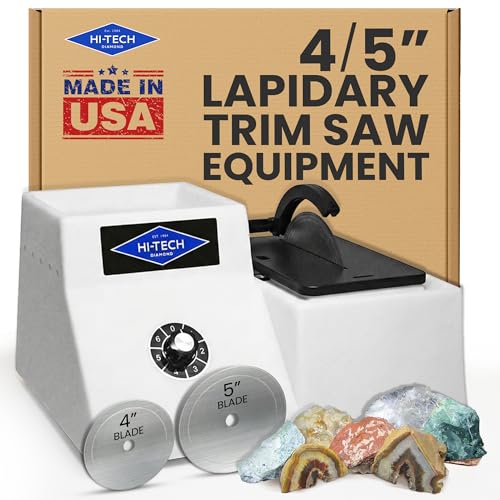
4″ / 5″ trim saw
A compact option for trimming small slabs and preparing preforms, with a choice of two blade diameters.
Check current price See model details
6″ trim saw
A dedicated trim saw for smaller rock work, with standard and vise-inclusive Amazon offerings.
Check current price See model detailsAs an Amazon Associate I earn from qualifying purchases. Check the current listing for price, availability and included accessories.
Keep the pattern and the label together
Mark which face is intended to be the top and note the orientation of the feature you want to display. When several similar blanks are in progress, label their photographs and storage positions. A reference image is useful if a faint layout line disappears during later work.
For matched earrings, photograph the two proposed outlines together before trimming. Decide whether “matched” means similar color, a mirrored pattern, equal dimensions or simply the same source material. Those definitions can lead to different layouts, and no saw specification can make that design decision for you.
Evaluate the blank before the next stage
Compare the resulting blank with the original outline and the requirements of the setting. Is the focal feature still centered? Have you preserved enough space for the final contour? Resolve those questions before investing time in detailed shaping or promising a particular finished size.
A dedicated trim saw can be a sensible starting point when your projects use purchased slabs. Hi-Tech Diamond describes its 6-inch model as intended for cabochon preforms. Compare documented dimensions and workspace needs in the model profile, then use the blade guide to verify any replacement rather than assuming the included blade defines every future option.
Questions about cabochon preforms
Can I cut an oval cabochon directly with a trim saw?
Do not steer a circular trim-saw blade through a curve. Plan straight cuts around an oversized blank and develop the final contour using suitable shaping equipment.
How much extra material should I leave around a preform?
Allow for the intended shaping process and the stone. Draw the final outline and a separate retained boundary; there is no universal allowance that suits every project.
Do I need to buy a slab saw to make cabochons?
Not necessarily. If you buy suitable slabs, a trim saw may cover the sawing stage. Cutting your own slabs from whole rough is a separate equipment requirement.
Sources and documentation
Compare current Amazon offers
4″ / 5″ trim saw
A compact option for trimming small slabs and preparing preforms, with a choice of two blade diameters.
Check current price See model details6″ trim saw
A dedicated trim saw for smaller rock work, with standard and vise-inclusive Amazon offerings.
Check current price See model detailsAs an Amazon Associate I earn from qualifying purchases. Check the current listing for price, availability and included accessories.
Keep exploring
Materials
Cutting Agates: Plan the Pattern Before the First Slice
Choose an agate cutting direction, plan slabs and preforms, compare blade requirements and preserve room for finishing.
Materials
Cutting Quartz and Jasper: Choose a Setup for the Actual Piece
Plan quartz and jasper cuts with material identification, suitable blade specifications, realistic layouts and a useful project log.
Blades and care
Lapidary Saw Blade Selection: Diameter, Arbor, Kerf and Bond
Compare lapidary blade specifications in the right order and distinguish machine compatibility from material suitability.