Choose a lapidary saw blade by clearing three gates in order: exact-machine fit, documented material and coolant suitability, then project tradeoffs such as kerf and price. Diameter and a 5/8-inch arbor are not enough. The selected blade also needs a documented maximum RPM that covers the machine speed used, an allowed mounting arrangement, adequate clearance and manufacturer support for the intended material.
Use an eight-field gate before comparing price
Write down the saw’s exact model and machine-label speed before searching. For each candidate, record the maker and part number, diameter, arbor, maximum rated RPM, rim or bond construction, core thickness, kerf, supported material and required coolant. These are separate fields; a seller title that supplies four of them has not answered the other questions.
Keep the selected variation’s documentation with the record. Marketplace parents can combine several diameters, thicknesses or arbor options, and the visible title may not update every specification clearly. Leave an unknown field visible rather than copying a value from a visually similar blade.
- Exact blade maker, part number and selected variation
- Diameter and arbor or manufacturer-approved bushing arrangement
- Blade maximum rated RPM and exact machine operating speed
- Rim or bond construction and documented material application
- Core thickness and kerf as two separately labeled measurements
- Required coolant, installation, guard clearance and care instructions
Screen the exact machine before the material
Hi-Tech’s current 4/5-inch trim-saw page documents 4- or 5-inch blades, a 5/8-inch arbor and an 800-to-3,400-RPM machine range. Its 6-inch page documents a 6-inch blade, the same 5/8-inch arbor and the same speed range. The 10-inch slab-saw page documents a 10-inch blade, a 5/8-inch arbor and 1,725 RPM; this site preserves a stricter 1,740-RPM checker screen because manufacturer guidance has conflicted. The exact machine label and supplied manual take priority.
A reducing bushing included with a blade does not authorize every possible installation. The blade and machine makers still need to permit the arrangement, and the guard, flange and table must retain their required clearance. Do not enlarge an arbor opening, remove a guard or alter the machine to rescue an uncertain purchase.
Keep maximum blade RPM separate from machine speed
The machine speed tells you what the saw can deliver; the blade’s maximum rated RPM is a ceiling for that exact blade. For the variable-speed trim saws, a candidate rated below 3,400 RPM fails this site’s conservative screen even if you intend to turn the dial down. A rating at or above the screen passes only the speed comparison—not construction, material, mounting or clearance.
None of the eleven saved Amazon offer titles shown in the blade collection states a maximum rated RPM. That does not prove the underlying blades lack a rating; it means the title alone cannot supply it. Open the exact variation’s manufacturer documentation or ask the blade maker. Do not enter the saw’s RPM into the Blade Checker as if it were the blade rating.
One relevant starting point

Gemking 10 Inch Lapidary Diamond Saw Blade, Ultra-Thin .040" x 5/8" Arbor, Continuous Sintered Notched Rim for Agate, Jade, Petrified Wood & Gemstones
Compare the listing specifications with your machine manual before choosing a blade.
Check current priceAs an Amazon Associate I earn from qualifying purchases. Check the current listing for price, availability and included accessories.
Read core, kerf and seller shorthand separately
Core thickness describes the blade body; kerf is the width associated with the cutting rim in the cited manufacturer’s specification order. Kerf belongs in material-loss planning. A marketplace title such as “.040 × 5/8 arbor” does not label the first value as core or kerf, so keep that field unresolved until the blade maker identifies it.
Even primary pages can disagree. Hi-Tech’s current 6-inch saw page lists the included red sintered blade as .015-inch core × .023-inch kerf, while its separate thin-sintered blade selector shows .016-inch core × .023-inch kerf for one variation. Preserve the conflict, record the exact part supplied and ask which specification applies instead of averaging or silently choosing a number.
Use construction as application evidence, not a ranking
Hi-Tech describes its thick notched blade as diamond grit pressed into the edge of a solid steel core and its thin sintered blade as diamond grit secured in a metal-bond rim through the rim depth. The cited applications differ too. Those facts help identify a candidate for a documented material; they do not establish that every notched or sintered marketplace blade shares the same design or suitability.
Both cited blade pages require wet use and direct the buyer to observe recommended operating speeds. Coolant permission, dressing instructions and care remain product-specific. A familiar construction word cannot substitute for those instructions, and the thinnest advertised blade is not automatically the best fit.
Turn the evidence into buy, hold or reject
Reject a candidate when diameter, arbor, rated RPM or an expressly documented material restriction conflicts with the machine or project. Hold when a necessary field is missing, a variation is ambiguous or the mounting arrangement needs manufacturer confirmation. Move to price and expected material loss only after the compatibility and application gates are documented.
For value, compare delivered price and any required approved accessories. Use the documented kerf in the Slab Yield Estimator, but leave blade life and cost per slab unknown without credible, comparable evidence. The product cards below preserve genuine manager-returned offers and matching photos; they identify shopping candidates and do not certify fit.
Common questions about lapidary saw blade selection
Does matching diameter prove a lapidary blade will fit?
No. Mounting, clearance and operating requirements still need checking for the exact machine and blade.
Is core thickness the same as kerf?
No. Core refers to the blade body; kerf refers to the cutting-rim width in the cited manufacturer’s terminology.
What if a blade listing does not state maximum RPM?
Keep the speed check unconfirmed. The machine speed is not a substitute for the blade’s own maximum rating; obtain the selected variation’s documentation or ask the blade maker.
Are sintered blades always better?
No universal ranking follows from the construction name. Compare documented suitability, specifications and care requirements for your project.
Sources and documentation
- Hi-Tech Diamond 4/5-inch trim saw diameter, arbor, speed and included blades
- Hi-Tech Diamond 6-inch trim saw diameter, arbor, speed and included blades
- Hi-Tech Diamond 10-inch slab saw diameter, arbor, speed and included blades
- Hi-Tech Diamond thin sintered construction and variation dimensions
- Hi-Tech Diamond thick notched construction and variation dimensions
Compare current Amazon offers
Gemking 10 Inch Lapidary Diamond Saw Blade, Ultra-Thin .040" x 5/8" Arbor, Continuous Sintered Notched Rim for Agate, Jade, Petrified Wood & Gemstones
Compare the listing specifications with your machine manual before choosing a blade.
Check current price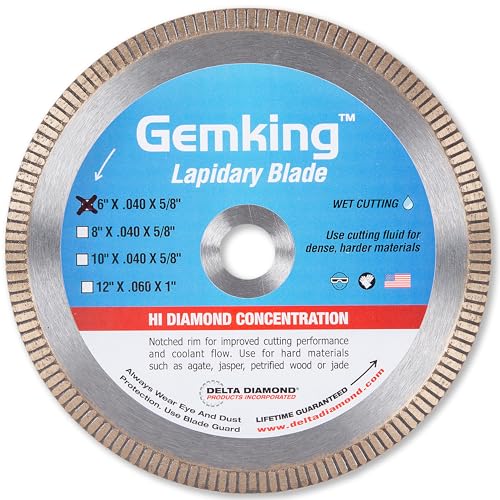
Gemking 6 Inch Lapidary Diamond Saw Blade, Ultra-Thin .040" x 5/8" Arbor, Continuous Sintered Notched Rim for Agate, Jade, Petrified Wood & Gemstones
Compare the listing specifications with your machine manual before choosing a blade.
Check current priceAs an Amazon Associate I earn from qualifying purchases. Check the current listing for price, availability and included accessories.
Keep exploring
Blades and care
Diamond Blade Dressing: When It Helps and When to Stop
Decide whether a lapidary blade needs cleaning, permitted dressing, replacement or manufacturer support without treating damage as dullness.
Ownership
Lapidary Saw RPM: Machine Speed vs Blade Limits
Understand lapidary saw RPM, blade maximum ratings and rim speed. Learn why a motor's highest setting is not a universal cutting recommendation.
Buying and setup
Lapidary Saw Cutting Capacity: Measure the Rock, Not the Blade
Compare lapidary saw blade diameter, exposed height and conservative rock-height screens without treating them as the same capacity number.
Projects
Cabochon Cutting and Preform Planning from a Slab
Plan cabochon preforms from a slab with an illustrative sizing example, straight relief cuts and accurate saw, blade and slab-yield checks.