There is no single correct RPM for every lapidary saw. Match the saw's operating speed to the blade manufacturer's approved range and application. A blade's maximum RPM is a limit, not a promise that the highest permitted speed gives the best cut.
Separate three different numbers
Record the machine's operating range, the blade's maximum rated RPM and any blade-maker recommendation for the material. Those numbers answer different questions. A speed dial describes the machine; a rating on a blade constrains its use; an application recommendation helps select an operating point within compatible limits.
Hi-Tech Diamond lists its 4/5-inch and 6-inch trim saws at approximately 800–3,400 RPM and its 10-inch slab saw at 1,740 RPM. Its FAQ also directs owners to respect blade RPM limits. These model facts should not be turned into an agate-specific speed chart without supporting blade instructions.
Manufacturer sources disagree on the 10-inch model’s fixed speed: the product page lists 1,725 RPM, while the FAQ and manual list 1,740 RPM. Confirm the label and current documentation for your exact unit before matching a blade. Our checker uses 1,740 RPM as its conservative screening value, not as a universal model specification.
Use a compatibility example before buying
Consider a hypothetical fixed-speed machine running at 1,800 RPM and a blade rated for a maximum of 1,500 RPM. That combination fails the speed check even if the diameter and arbor appear to fit. A blade rated above the machine speed passes only this one check; material, mounting and other compatibility requirements still remain.
On a variable-speed machine, an unreadable blade label remains an unresolved problem. The presence of a lower dial position does not reveal the missing rating. Request the specification using the exact blade part number, and preserve the answer with your purchase record.
Understand why diameter changes the comparison
RPM counts revolutions each minute. The distance traveled by a point on a circular rim during one revolution is the circumference. Consequently, two different diameters at identical RPM have different rim speeds. This is geometry, not a recommendation to alter a saw or install a larger blade.
For an illustrative calculation, a 6-inch circle at 1,000 RPM has a rim speed of about 1,571 feet per minute: diameter in inches multiplied by pi and RPM, then divided by 12. A 10-inch circle at that same RPM gives about 2,618 feet per minute. Neither calculated value establishes a safe or effective operating setting.
Relevant equipment to compare
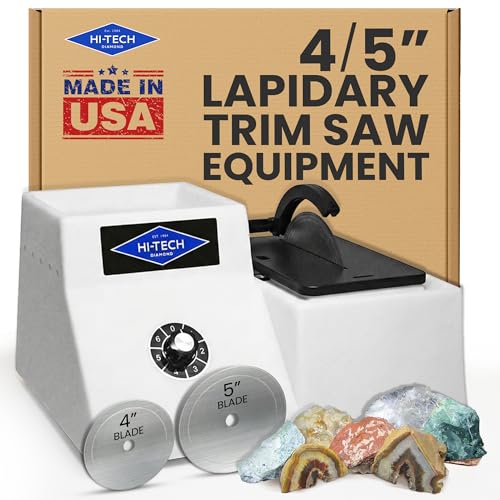
4″ / 5″ trim saw
A compact option for trimming small slabs and preparing preforms, with a choice of two blade diameters.
Check current price See model details
6″ trim saw
A dedicated trim saw for smaller rock work, with standard and vise-inclusive Amazon offerings.
Check current price See model detailsAs an Amazon Associate I earn from qualifying purchases. Check the current listing for price, availability and included accessories.
Keep a useful cutting record
A notebook entry becomes useful when it identifies the blade, stone and setup alongside the selected speed. 'Medium worked better' is hard to reproduce after replacing a blade or changing machines. A clearer note gives the machine model, blade part number, approved setting, material dimensions and the observed result.
Do not build a personal speed chart around unidentified rocks or undocumented equipment. Begin with the maker's guidance, and record only adjustments that guidance permits. Changes in stock thickness or workholding can make two sessions poor comparisons even when both involve the same named mineral.
- Record the source of the blade rating, not just the number.
- Distinguish an approximate dial position from a measured spindle speed.
- Keep cutting observations separate from claims about the cause of a problem.
Do not use speed to bypass another problem
A reluctant cut is a diagnosis question before it is a speed question. Ask whether the machine and blade suit the job, whether the setup matches the instructions and whether the behavior changed after a specific event. Our troubleshooting guide organizes that investigation without assuming every symptom means a dull blade.
If the manufacturer cannot establish the appropriate operating range for your proposed combination, choose a documented combination instead. A clear compatibility answer is more valuable than a higher advertised motor speed when purchasing your first saw.
Questions about lapidary saw rpm
Should I run a lapidary saw at maximum speed?
Not automatically. The machine and blade instructions govern, and a maximum rating is a ceiling rather than a universal optimum.
Does a larger saw need the same RPM as a small saw?
Do not transfer settings between diameters. Rim speed changes with diameter, and the appropriate operating conditions depend on the particular machine and blade.
Can the Blade Checker choose my cutting RPM?
It can organize documented compatibility information. It cannot manufacture a missing blade rating or replace application instructions from the manufacturer.
Sources and documentation
Compare current Amazon offers
4″ / 5″ trim saw
A compact option for trimming small slabs and preparing preforms, with a choice of two blade diameters.
Check current price See model details6″ trim saw
A dedicated trim saw for smaller rock work, with standard and vise-inclusive Amazon offerings.
Check current price See model detailsAs an Amazon Associate I earn from qualifying purchases. Check the current listing for price, availability and included accessories.
Keep exploring
Blades and care
Lapidary Saw Blade Selection: Diameter, Arbor, Kerf and Bond
Compare lapidary blade specifications in the right order and distinguish machine compatibility from material suitability.
Ownership
Lapidary Saw Troubleshooting: Slow Cuts, Spray and Wobble
Organize lapidary saw problems by symptom and recent changes. Know when to stop, what to record and when manufacturer service is the right next step.
Buying and setup
Lapidary Saw Cutting Capacity: Measure the Rock, Not the Blade
Understand exposed blade height, conservative planning limits, vise clearance and why blade diameter does not equal rock cutting capacity.