For a beginner working from purchased slabs, start by comparing a supported trim saw with the workholding and clearance your pieces need. If your starting material is bulky rough, assess a slab saw instead. The right first saw follows your material, not a universal best-machine ranking.
Start with the material already on your bench
Lay out five pieces you actually intend to cut. Record whether each is a flat slab, a small irregular offcut, or a larger piece of rough. Measure the height at the proposed cut and note whether there is a stable face. A saw that fits most of this real collection is a more useful purchase than one chosen around a single imagined future project.
Write down the next operation too. Trimming a cabochon outline, opening a nodule, and making several parallel slices are different jobs. If you want polished jewelry, the purchase plan must include the later shaping and polishing stages; a cutting machine does not finish the entire project.
Build a shortlist around control and support
Our editorial starting point is a documented machine with an obtainable manual, identifiable replacement blades, and a reachable service department. Those features make it easier to resolve a first setup problem and confirm an accessory before ordering it. We do not describe this as a hands-on performance ranking.
For the Hi-Tech family, the 4/5-inch model is a compact trimming option, the 6-inch is the next trim-saw comparison, and the 10-inch belongs in the larger-material discussion. Read the individual profiles before choosing. A familiar brand name does not establish whether the selected listing includes a vise or suits the stone in your hand.
Check clearance before blade diameter
Blade diameter describes the wheel, not the thickness of rock a machine can automatically accept. The table, arbor, guard and workholding take up space. Manufacturer-listed exposed blade height is a useful screening measurement, but it is not a promise that every irregular stone of that height can be held and fed correctly.
Do not derive safe capacity by halving the blade diameter or by assuming you can flip an oversized rock and finish from the other side. Send the manufacturer a measured description or photograph when clearance or holding is doubtful. Rule out a machine if its intended setup cannot support your proposed cut.
Relevant equipment to compare
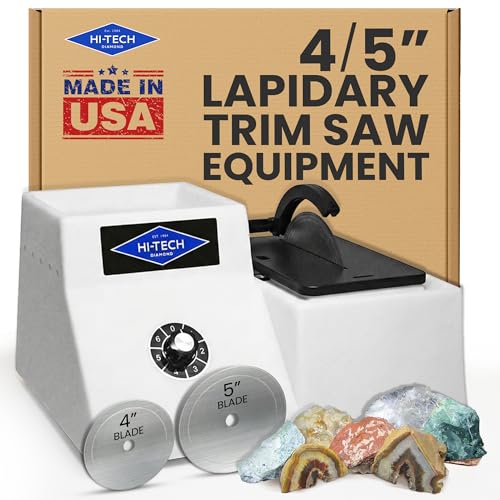
4″ / 5″ trim saw
A compact option for trimming small slabs and preparing preforms, with a choice of two blade diameters.
Check current price See model details
6″ trim saw
A dedicated trim saw for smaller rock work, with standard and vise-inclusive Amazon offerings.
Check current price See model detailsAs an Amazon Associate I earn from qualifying purchases. Check the current listing for price, availability and included accessories.
Budget for a complete first session
Compare the delivered saw configuration, the correct blade for your material, approved workholding, eye protection, a stable work surface, and coolant requirements. Include a place to collect cleanup residue. Treat a spare blade as a separate choice rather than counting every bundled accessory as an automatic saving.
Our suggested buying worksheet has three columns: needed now, useful later, and already owned. This prevents an inexpensive bare machine from winning against a more complete setup simply because the comparison omitted its missing pieces. Keep spending on speculative accessories out of the first column.
Make the first purchase reversible
Before checkout, read the seller's return conditions and the manufacturer's warranty terms. Save the listing configuration and invoice. Ask a local club about instruction or a supervised session if you have never used a lapidary saw; seeing the complete workflow can clarify your preferences before buying.
Plan a modest first project with appropriate, identified material. Follow the exact manual for installation and use, including guards, lubrication and maintenance. The Hi-Tech 4/5-inch manual requires wet operation and straight cuts; it does not turn a small diamond saw into a freehand curve-cutting tool. Start with a realistic task and expand only when your equipment and technique support it.
Questions about best lapidary saw for beginners
Is a 6-inch lapidary saw always best for a beginner?
No. A beginner buying slabs may need a trim saw, while someone preparing larger rough needs a different setup. Compare the actual piece, intended cut and workholding before choosing a size.
Should I buy a saw before a polishing machine?
Map the whole project first. Buying prepared slabs or using a club saw may let you start with shaping and polishing. Buy a saw when cutting is the step you need to bring into your own workspace.
Do these recommendations come from hands-on testing?
No. They are editorial choices based on documented specifications and workflow requirements. They do not claim measured cutting speeds, durability testing or personal ownership.
Sources and documentation
Compare current Amazon offers
4″ / 5″ trim saw
A compact option for trimming small slabs and preparing preforms, with a choice of two blade diameters.
Check current price See model details6″ trim saw
A dedicated trim saw for smaller rock work, with standard and vise-inclusive Amazon offerings.
Check current price See model detailsAs an Amazon Associate I earn from qualifying purchases. Check the current listing for price, availability and included accessories.
Keep exploring
Comparisons
Trim Saw vs Slab Saw: Match the Machine to the Cut
Learn when you need a trim saw, slab saw or combination machine, with practical checks for rough rock, cabochons and repeat slices.
Buying guides
How Much Does a Lapidary Saw Cost? Budget Beyond the Machine
Plan lapidary saw costs across compact trimming, larger rough cutting, blades, workholding, delivery and ongoing ownership.
Buying guides
Compact Lapidary Saws: Plan a Small Cutting Workspace
Choose a compact lapidary saw using bench dimensions, operating space, cleanup access and the material you intend to trim.