Choose a compact lapidary saw by its complete working arrangement, not blade size alone. Measure the machine footprint, the space to handle your material and the access needed for cleaning. A small saw that must be awkwardly moved every session may be a poor fit even when it fits on a shelf.
Measure the working space and storage separately
Start with two measurements: where the saw will operate and where it will be stored. A shelf opening tells you little about whether you can comfortably prepare material, reach the controls or remove a table for cleaning. Sketch both spaces before comparing machines.
Our suggested layout test is to make a paper template of the published footprint and place it on the proposed bench. Add paper markers for incoming pieces, finished pieces and a cleanup container. This does not certify the installation, but it exposes obvious crowding before an expensive machine arrives.
Compare actual dimensions rather than photographs
Hi-Tech lists its 4/5-inch saw at 13 by 9.5 by 7 inches and 10 pounds. Its 6-inch model is listed at 17 by 17 by 11 inches and 15 pounds. Those are machine specifications, not recommended operating clearances. Confirm the exact current model and allow the additional space its manual requires.
The practical choice is not simply which dimension is smallest. Think about the route from storage to the bench, your ability to move the equipment as directed, and whether the workspace can remain prepared between sessions. A machine that fits but is inconvenient to set up may discourage regular use.
Keep compact size separate from stone capacity
A small work area can be compatible with modest trimming projects, but a large piece of rough does not become suitable just because it can be balanced on the table. Check the planned cut and supported holding arrangement before judging a machine by its overall footprint.
Published exposed blade height is only one screening dimension. It must not be converted into a guaranteed capacity for every stone of equal height. The geometry of the piece and its fixture can reduce usable space. Do not plan to overcome an uncertain fit by removing a guard, using an unsupported orientation or assuming a second pass will solve the problem.
Relevant equipment to compare
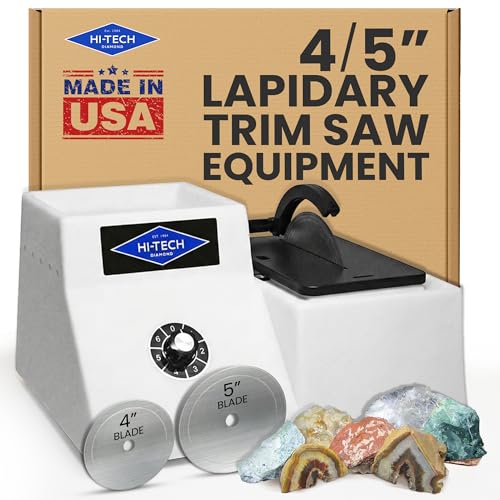
4″ / 5″ trim saw
A compact option for trimming small slabs and preparing preforms, with a choice of two blade diameters.
Check current price See model details
6″ trim saw
A dedicated trim saw for smaller rock work, with standard and vise-inclusive Amazon offerings.
Check current price See model detailsAs an Amazon Associate I earn from qualifying purchases. Check the current listing for price, availability and included accessories.
Make cleanup part of the layout
Before purchase, read how the manufacturer expects the machine to be emptied, cleaned and stored. Trace where the collected liquid and residue will go. A convenient cutting position becomes less convenient if routine cleanup requires carrying equipment through a crowded room.
Keep the work surface organized so the operating instructions remain practical to follow. The Hi-Tech 4/5-inch manual specifies a sturdy, level surface and an indoor installation. It also calls for cooling intervals during use. For this model, portability therefore does not mean outdoor suitability or continuous all-day operation.
Buy for the projects that fit the room
Write down the next ten projects you expect to complete. If nearly all involve trimming prepared slabs, investigate a compact trim station first. If most begin with rough beyond a small machine's documented envelope, consider outside preparation or a more suitable location before buying.
Our editorial preference is a modest setup that fully supports the intended work. Do not let the available shelf dictate an unsuitable cutting method. Take the same approach to accessories: reserve space for what the project requires, and postpone speculative additions until there is a clear use and a place for them. A small studio works best when its workflow is deliberate.
Questions about compact lapidary saws
Can a compact lapidary saw be used on a kitchen table?
Use only a location that satisfies the machine manual and provides a suitable dedicated working arrangement. A convenient household surface does not automatically meet stability, electrical, splash or cleanup needs.
Does a portable saw mean I can use it outdoors?
No. Check the exact manual. The Hi-Tech 4/5-inch manual specifies indoor use, so low weight is not an outdoor-use rating.
Is the smallest saw the best choice for an apartment?
Not necessarily. Evaluate your permitted workspace, material, noise considerations and cleanup arrangement first. Club access or outside cutting may be a better fit when an appropriate installation is unavailable.
Sources and documentation
Compare current Amazon offers
4″ / 5″ trim saw
A compact option for trimming small slabs and preparing preforms, with a choice of two blade diameters.
Check current price See model details6″ trim saw
A dedicated trim saw for smaller rock work, with standard and vise-inclusive Amazon offerings.
Check current price See model detailsAs an Amazon Associate I earn from qualifying purchases. Check the current listing for price, availability and included accessories.
Keep exploring
Buying guides
Best Lapidary Saw for Beginners: Choose by Your First Project
Choose a first lapidary saw for cabochon trimming or rough rock. Compare workholding, usable clearance, support and the complete setup.
Comparisons
Hi-Tech 4/5 vs 6-Inch Trim Saw: Which Fits Your Projects?
Compare Hi-Tech compact trim saws by working area, exposed blade height, handling and vise options without invented test results.
Buying guides
How Much Does a Lapidary Saw Cost? Budget Beyond the Machine
Plan lapidary saw costs across compact trimming, larger rough cutting, blades, workholding, delivery and ongoing ownership.