Buy a used lapidary saw only after confirming its identity, completeness, documented operating requirements and repair options. A low asking price is not a useful saving when essential parts are missing or the required repair cannot be priced. Inspect with the power disconnected; use qualified help for electrical or mechanical concerns.
Identify the exact machine before travelling
Ask the seller for photographs of the model plate, serial number if present, controls, blade area, table and included accessories. Request the manual and any service records. If the model cannot be established, treat that as an unresolved question rather than assuming it matches a similar-looking current product.
Create a short inventory from the correct manual. Mark each required part as present, missing or unclear. Ask the seller to clarify the unclear items before making a long trip. Keep notes of the voltage and configuration so you do not compare the asking price against the wrong new-machine listing.
Inspect completeness and visible condition
With the machine disconnected, inspect accessible guards, supports, table components, fasteners and the visible cord condition. Look for modifications and ask why they were made. Do not remove electrical covers or run a damaged machine to see whether it still works.
Our buying checklist treats an unexplained missing guard, damaged cable, cracked structural part or unknown modification as a reason to pause the purchase. A qualified repair assessment can establish whether the equipment is worth pursuing. A seller's statement that it has always worked does not replace an inspection or a repair quotation.
Ask about the work it has done
Find out what materials were cut, which coolant was used, how the machine was stored and why it is being sold. Ask whether the current blade belongs to the machine and whether any accessories came from another model. Record the answers without treating them as independently verified facts.
If an operating demonstration is appropriate, arrange it only after the equipment has been found suitable for operation and under the correct manual's conditions. Let a competent operator demonstrate the supported task. You are evaluating a potential purchase, not conducting improvised fault diagnosis or experimenting with an unknown setup.
Relevant equipment to compare
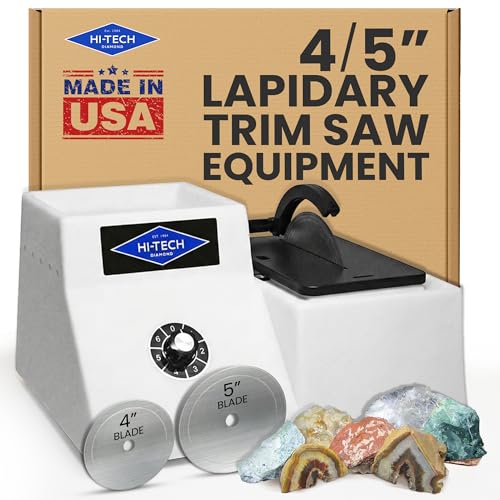
4″ / 5″ trim saw
A compact option for trimming small slabs and preparing preforms, with a choice of two blade diameters.
Check current price See model details
6″ trim saw
A dedicated trim saw for smaller rock work, with standard and vise-inclusive Amazon offerings.
Check current price See model detailsAs an Amazon Associate I earn from qualifying purchases. Check the current listing for price, availability and included accessories.
Price repairs before negotiating
Confirm which replacement parts and services remain available for the identified model. Hi-Tech's FAQ states that it does not sell motors for customer installation and directs motor replacement to its repair service. That is a useful example of why an apparently simple repair should not be priced from a generic component listing.
Ask for a written estimate that covers the actual fault, shipping if required and any inspection charge. When diagnosis remains uncertain, record a range or leave the total unresolved. Do not convert a seller's guess into a guaranteed restoration budget. Missing accessories should also be priced by the exact compatible part.
Compare total risk with a new alternative
Use a worksheet with asking price, collection or delivery, required parts, quoted service and needed accessories. Add a separate note for unresolved faults. Compare that result with a complete new configuration and its current support terms. Your comfort with repair projects matters as much as the arithmetic.
Check warranty transferability directly. The Hi-Tech 4/5-inch manual states that its warranty covers the original purchaser and is not transferable; do not assume a secondhand purchase inherits remaining cover. Our editorial rule is simple: buy a known machine at a known total cost when possible. If the identity, condition or repair path remains unclear, keep looking rather than forcing the deal to work.
Questions about used lapidary saw checklist
What is the first thing to check on a used lapidary saw?
Identify the exact model and configuration, then obtain its manual. Without that baseline you cannot reliably judge completeness, intended use or replacement-part compatibility.
Should I test a used saw before buying it?
An appropriate demonstration can help after the equipment is established as suitable to operate. Do not energize a visibly damaged or questionable machine; arrange qualified inspection first.
Does a used Hi-Tech saw keep its warranty?
Do not assume so. The cited 4/5-inch manual limits warranty coverage to the original purchaser. Check the terms for the particular model and purchase before assigning value to remaining coverage.
Sources and documentation
Compare current Amazon offers
4″ / 5″ trim saw
A compact option for trimming small slabs and preparing preforms, with a choice of two blade diameters.
Check current price See model details6″ trim saw
A dedicated trim saw for smaller rock work, with standard and vise-inclusive Amazon offerings.
Check current price See model detailsAs an Amazon Associate I earn from qualifying purchases. Check the current listing for price, availability and included accessories.
Keep exploring
Buying guides
How Much Does a Lapidary Saw Cost? Budget Beyond the Machine
Plan lapidary saw costs across compact trimming, larger rough cutting, blades, workholding, delivery and ongoing ownership.
Buying guides
Best Lapidary Saw for Beginners: Choose by Your First Project
Choose a first lapidary saw for cabochon trimming or rough rock. Compare workholding, usable clearance, support and the complete setup.
Comparisons
Trim Saw vs Slab Saw: Match the Machine to the Cut
Learn when you need a trim saw, slab saw or combination machine, with practical checks for rough rock, cabochons and repeat slices.